
SPR Diary
Shopping from the Future: Yellow Door Autonomous Stores
5 minutes read
date
author
Mario Vaklinov
business
brand identity
Imagine a store that opens just for you. The key is always in your pocket, and product prices are set live, based on your shopping habits. There’s never a line at the checkout, and you set the pace of your shopping yourself.
After several years of development and testing, on October 1st this year, the entrepreneurial brothers Asen, Alexander, and Petar Vitanov unveiled the store of the future – Yellow Door.
How does Yellow Door work?
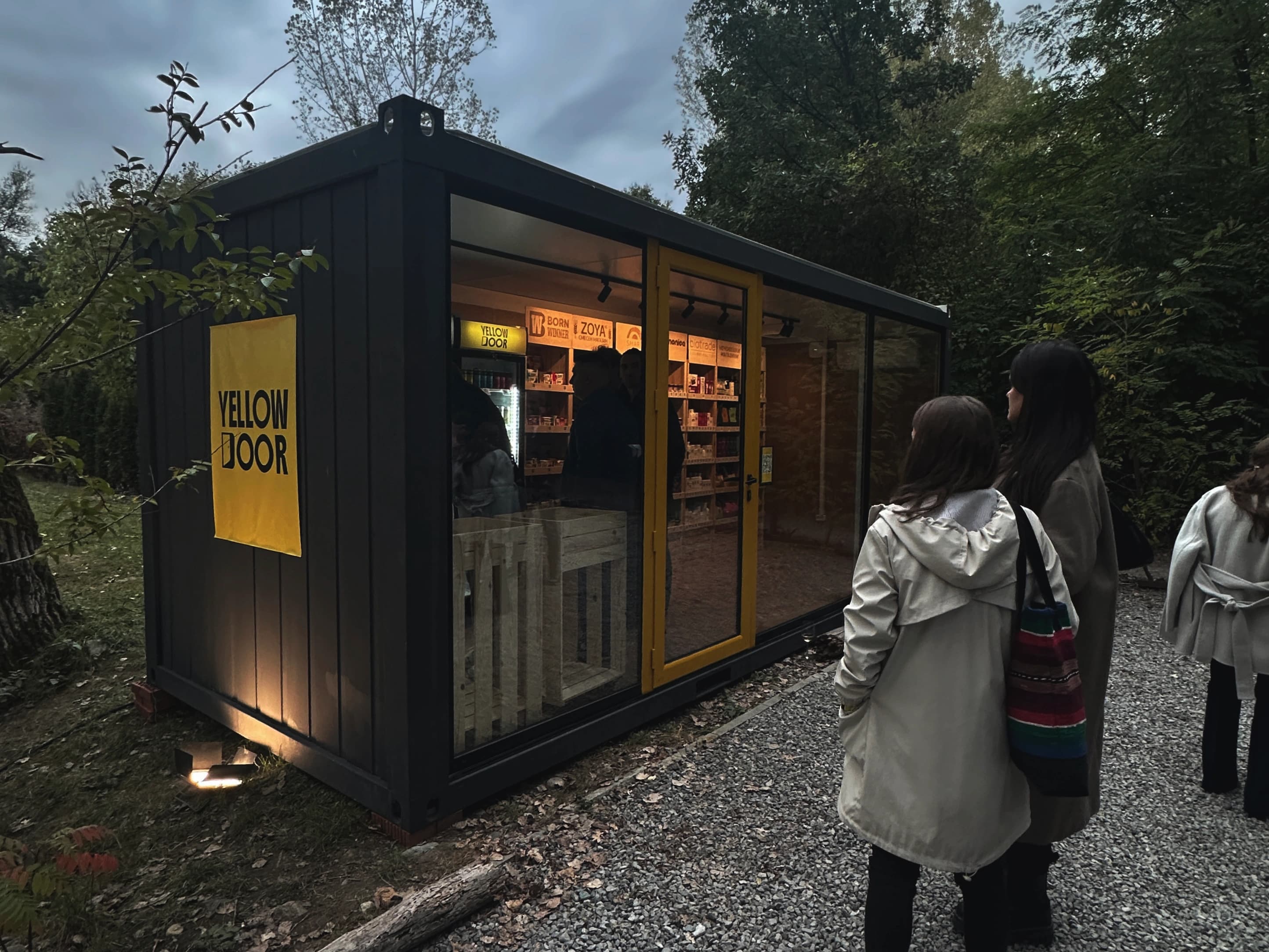
At first glance, Yellow Door looks like a neatly arranged store offering a variety of goods. What’s missing, however, is a checkout counter and a cashier. Approaching its yellow door, we notice a QR code that takes us to the My Yellow Door mobile app in the App Store. After a quick registration, we can unlock the store using our phone. Shopping time begins!
Among the shelves, you won’t see price tags. That’s because Yellow Door offers personalized pricing for every user. This is made possible by the technology behind the mobile app, which tracks our favorite products. All we need to do is point our phone’s camera at the shelves to see the digital price tags in real time.
To add a product to our basket, we simply scan its barcode with our phone’s camera. Payment takes only seconds, again within the app.
Yellow Door gives us time to pack our purchases at ease, politely opening the exit door the moment we tap the “I’m ready” button.
Why are autonomous stores the shortcut to the future?
With rising living standards, product prices, and labor costs, more and more small and large businesses are being forced to close their retail locations, both in big cities and in smaller towns. At the same time, with the rise of new technologies, contactless payments, and self-checkout counters, the role of the cashier is gradually losing its meaning.
As Asen Vitanov noted during the Yellow Door presentation, these people (cashiers) are practically living barcode scanners who, in a better world, could contribute much more to their work if given the chance to put their thought, heart, and soul into roles such as consultants.
The need for autonomous stores is not only tied to paying salaries and taxes for employees. Finding and retaining staff for such positions is becoming increasingly difficult. At the same time, the working conditions for staffed locations are heavily burdened by sanitary requirements, which make setting up a retail store an even more complex task.
A store the size of a parking space
Beyond the technological possibility of opening a retail store without staff, Yellow Door is developing a turnkey solution for a multifunctional shop that can open with nothing more than an electricity supply and rented ground space. This is made possible through a transportable container customized for autonomous shopping. The front side of the container is made entirely of glass so that the goods are visible from afar.
Only the door frame is painted yellow to strengthen the brand’s recognition. Such shops could be operated entirely by the parent company or by partners who use Yellow Door’s technology.
These compact, easy-to-transport shops will be equipped with cameras and an automated AI surveillance system to prevent theft. Customers will also be able to charge their mobile devices while shopping.
Who can open a Yellow Door store?
Attempts at autonomous retail are already part of our daily lives. We see them at gas stations developing self-checkout counters, in the familiar vending machines, and increasingly in clothing stores that minimize staffed checkouts.
Yellow Door offers proven technology and customizable retail units applicable not only to food but also to cosmetics and countless other industries. At the opening, the company even shared that negotiations with pharmaceutical partners are underway. Of course, before such stores can appear everywhere around us, issues related to the purchase of prescription medicines must be resolved—something that, for now, in Bulgaria cannot happen without the presence of a pharmacist. Yellow Door also raised the topic of the lack of retail shops for essential goods in remote and sparsely populated areas.
Personal philosophical reflections
Listening to the Yellow Door presentation made me reflect on technology as a thief of jobs. The romantic in me still finds charm in going to the corner shop with nothing more than a house key, a 5 leva bill, and a few coins in my pocket. To greet the ladies at the neighborhood store with a “hello, girls!” and wish each other a good day.
The advancement of technology should not necessarily mean the death of small businesses and local shops. On the contrary—just as Gen Z has started listening to music on MP3 players and buying CDs at the very moment when laptops and cars no longer come with disc readers—I believe that the value and appeal of small, human-run stores deserve to be appreciated.
A friend of mine from England moved to Sofia about a week ago and was impressed precisely by the number of small neighborhood businesses, which we (locals) often pass by indifferently on our way to the supermarket, where we’re certain we’ll find everything we are looking for. Because in London, it’s hard to find a bookstore where the owner is also the seller, personally deciding what to put on the shelves.
Gratitude
On behalf of Studio Priority, I’d like to thank Yellow Door for the collaboration on creating their logo. Thanks to Asen, Alexander, and Petar for thanking their families on stage! :) And for choosing to dedicate their lives to solving problems here at home, when they have the talent to do it from anywhere in the world.
Thanks also to Steli and Veni from Studio Voilà, without whom this collaboration would not have been possible.